What makes a great investor pitch deck for a deep tech company?

You can have genuinely groundbreaking technology and still struggle to convince someone it's worth investing in. That doesn't necessarily mean there's anything wrong with the innovation. Sometimes, the challenge is explaining why it matters beyond the people who already understand it.
Deep tech companies face a particularly interesting version of this problem. Whether they're developing new materials, advancing biotechnology, or rethinking how energy is produced, the underlying technology can take years to develop and require substantial investment before reaching commercial scale.
I've worked on investor presentations for companies operating in technically complex industries, and they're some of my favourite design challenges. There's usually an enormous amount of information to work with: research, intellectual property, market analysis, technical processes, financial projections, and ambitious plans for the future. The difficulty isn't finding enough to say. It's deciding what matters most.
A great investor deck doesn't need to explain every detail of the technology. It needs to make a convincing case for why that technology has the potential to become a successful business.
Start with the problem, not the science
When you've spent years developing something innovative, it's understandable to want to begin by explaining how it works. After all, the technology is probably the most exciting part of the business. But for someone encountering your company for the first time, the scientific breakthrough may not mean much without understanding the problem it solves.
Imagine a company developing a new process for extracting critical minerals. The underlying chemistry might be fascinating, but an investor first needs to understand why existing extraction methods are inadequate, what makes the alternative commercially attractive, and whether there's a meaningful market for it.
The technical explanation becomes much more valuable once that context is established.
This doesn't mean every company needs to lead with an emotional story or an exaggerated statement about changing the world. Sometimes the problem is a measurable inefficiency, a manufacturing limitation, or a scientific challenge that has prevented an industry from progressing. What's important is establishing why solving it creates value.
The strongest opening slides give investors a reason to care about the technology before asking them to understand it.
Explain what makes your technology genuinely different
Deep tech companies often have a technical advantage that forms the foundation of their competitive position. It might be a proprietary manufacturing process, a novel scientific mechanism, a new approach to computation, or intellectual property that would be difficult for competitors to reproduce.
Communicating that advantage is essential, but it's also where presentations can become unnecessarily complicated.
I've found that technical diagrams can be particularly useful here. Rather than trying to explain an entire process through paragraphs of text, a well-structured visual can show how something works, where the innovation occurs, and why it represents an improvement over existing approaches. Comparisons can be equally effective when they establish a clear, meaningful difference between the technology and the alternatives already available.
The important thing is connecting technical performance to practical value. A technology that operates at a lower temperature, for example, might reduce energy consumption or manufacturing costs. A new diagnostic method might offer improvements in accuracy, processing time, or accessibility. Those benefits are often easier to evaluate than the technical specifications alone.
But comparisons need context. What was the technology tested against? Under what conditions? Is the improvement demonstrated or projected? Without that information, even an impressive result can be difficult to interpret.
Technical credibility doesn't come from using complicated language. It comes from making clear, specific claims and supporting them with appropriate evidence.
Show what's been proven and what still needs proving
One of the biggest differences between pitching a conventional software business and a deep tech company is the nature of the risk involved.
A software startup might be able to demonstrate an established product, paying customers, and recurring revenue relatively early. A biotechnology or advanced materials company may still be conducting research, validating prototypes, or preparing for regulatory approval.
That doesn't make the opportunity less interesting, but it changes the evidence investors need to evaluate.
Deep Checks, which has developed sector-specific fundraising guidance with deep tech investors, emphasises the importance of distinguishing between what has already been demonstrated and what remains technically uncertain. Its guidance for biotechnology companies, for example, separates scientific, manufacturing, and execution risks rather than treating them as one problem.
I think this distinction is especially important when designing technical presentations. It's easy for a slide to look convincing while leaving the maturity of the technology unclear. Laboratory results can appear alongside commercial projections without explaining the development stages between them. A successful proof of concept can be presented in a way that suggests a product is much closer to market than it actually is.
Good information design should make these differences easier to understand, not obscure them.
A development roadmap, for instance, can show completed validation, current work, and the milestones required before commercialisation. Technical results can be accompanied by clear explanations of their scope and limitations. And risks can be presented alongside the experiments or engineering work intended to address them.
Investors don't necessarily expect every uncertainty to have been resolved. They need confidence that the company understands what remains to be done.
A large market isn't the same as a commercial opportunity
Almost every investor deck includes a market-size slide. For deep tech businesses, those numbers can be enormous. A technology might have applications across energy, agriculture, manufacturing, healthcare, and several other industries.
That's exciting, but it can also make the business harder to evaluate.
A company developing an innovative material could potentially address several billion-dollar markets. The more useful question is often which market it can enter first, what customers in that market actually need, and why they would choose the new technology over existing alternatives.
A large total addressable market doesn't necessarily translate into a realistic commercial opportunity. There may be significant barriers to adoption, established competitors, regulatory requirements, or costs associated with changing existing systems.
This is where the relationship between technical development and commercial strategy becomes important. Investors need to understand not only whether the technology works, but whether it can be manufactured, delivered, licensed, or deployed at a cost that makes sense.
That might involve explaining production economics, a regulatory pathway, customer partnerships, or how the business expects to generate revenue. The details vary significantly between industries, but the underlying question is similar: how does the innovation eventually become a viable business?
A convincing deck connects the long-term potential of the technology to a believable starting point.
Don't overlook the people behind the technology
When the innovation itself is so sophisticated, it's easy to devote most of the presentation to the research and leave the team until the end. But investors aren't only evaluating what's being developed. They're evaluating the people responsible for turning it into a business.
Dropbox DocSend's 2024 fundraising research found that investors spent 40% more time on team slides in seed-stage presentations compared with the previous year. That's a finding from the broader startup fundraising market rather than deep tech specifically, but it reinforces how important the people behind a business can be to an investment decision.
For a deep tech company, relevant experience might include scientific research, previous commercialisation work, manufacturing expertise, regulatory knowledge, or relationships within the target industry.
A good team slide communicates more than names, qualifications, and impressive previous employers. It helps explain why these particular people are equipped to solve the problem, navigate the risks, and build the company they're proposing.
For early-stage businesses especially, the team's experience can be an important part of the investment case when there is limited commercial traction to demonstrate.
Good design makes the evidence easier to evaluate
There's a practical reason to be selective about what goes into an investor presentation: people may spend very little time reviewing it.
Papermark's 2026 fundraising report analysed 24,541 pitch decks and 358,672 investor views. It found that 16% of views ended within the first ten seconds. The dataset isn't limited to deep tech companies, and it doesn't establish whether presentation design determines funding outcomes. But it does demonstrate how quickly some initial reviews can end.
For a technically complex business, that makes visual hierarchy particularly important.
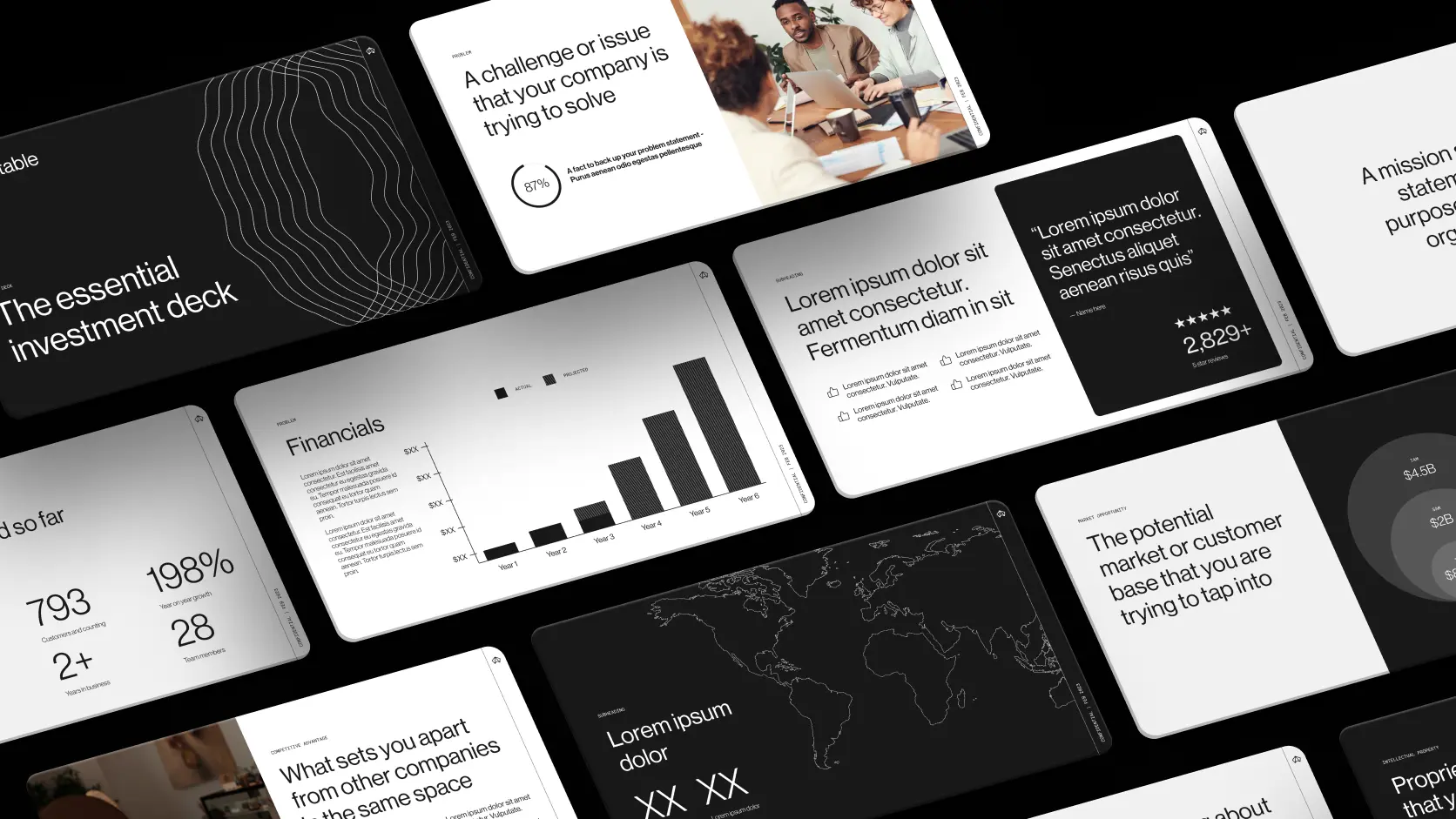
One of the things I pay close attention to when designing presentations is whether someone can understand the main point of a slide without reading every word. A clear headline should communicate the conclusion, not simply announce the topic. Charts should highlight meaningful relationships rather than ask the audience to interpret an entire dataset. Technical diagrams should guide the viewer through a process instead of presenting every component with equal importance.
Sometimes this means removing information. Other times it means restructuring it, making comparisons more obvious, or moving detailed evidence into an appendix where interested investors can explore it further.
Y Combinator's guidance on pitch deck design makes a similar point: slides should be legible, simple, and immediately understandable. Although that advice was originally developed for startup presentations, the principles are particularly relevant when the subject matter is complicated.
I also think there's a responsibility that comes with visualising technical information. A beautifully designed chart is not necessarily an accurate one. Axes, baselines, assumptions, and the distinction between measured and projected results all matter. Design should help investors understand the evidence, including its limitations.
The objective isn't to make everything appear more impressive. It's to make the information easier to assess.
Make the funding ask mean something
An investor deck ultimately needs to explain what the business is raising and what it intends to achieve with that capital. For deep tech companies, the relationship between funding and technical progress deserves particular attention.
Rather than presenting a generic breakdown of expenditure, a useful funding slide connects investment to meaningful development milestones. That could mean completing independent validation, advancing a clinical programme, demonstrating a manufacturing process at pilot scale, or securing the evidence required for commercial partnerships.
Investors should be able to understand what the company expects to have achieved by the end of the funding period, what uncertainties will have been reduced, and what those results could unlock next.
It's particularly important to be realistic about timelines. Scientific development doesn't always follow a predictable schedule, and manufacturing, regulatory approval, and commercial adoption can introduce challenges that aren't immediately obvious.
An ambitious roadmap is valuable, but an achievable one is much more convincing than a series of optimistic milestones without a clear explanation of how they'll be reached.
The best investor decks are built around understanding
I don't believe a beautifully designed presentation can compensate for weak research, an unrealistic commercial strategy, or a technology that doesn't deliver what it promises. Nor should it try to.
But I do think there's a significant difference between having a compelling investment opportunity and communicating one effectively.
For deep tech businesses, that means bringing together several very different types of information: scientific evidence, technical differentiation, commercial strategy, financial expectations, and the experience of the team. Each needs to be understandable on its own, but the real value comes from showing how they support the same argument.
That's what makes investor presentation design such interesting work. You're not simply making slides look good. You're helping turn years of research, engineering, and commercial thinking into a coherent explanation of why a company deserves attention.
The strongest pitch decks don't make complex technology seem less complex than it is. They help investors understand what makes it valuable, what remains uncertain, and why the opportunity is worth exploring further.
Because ultimately, a great investor deck doesn't just explain what a company has built. It makes a credible case for what that company could become.
Research referenced
- Papermark — Fundraising Report 2026
- Dropbox DocSend — 2024 Venture Capital Fundraising Research
- Y Combinator — How to Design a Better Pitch Deck
- Y Combinator — A Guide to Seed Fundraising
- Deep Checks — Biotech Fundraising Guide
- Deep Checks — Energy Fundraising Guide